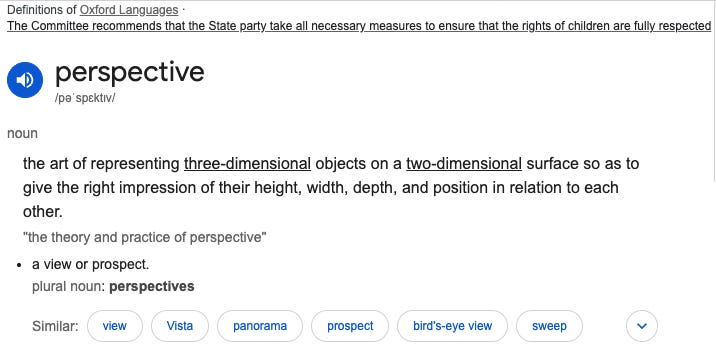
The Oxford Dictionary defines perspective as follows:
When I use the word perspective, I point to something less physical: The view I have on something - be it a topic, a challenge, a situation, another person, etc. When I use it, it says more about my standpoint than the object; it is more about how I look at something, how I position myself towards the object, not about how I position the object on a two-dimensional surface.
This is important to distinguish because the object that I have in my mind when using this word is not necessarily something I can just take and change its place like a flower vase. How do I then change something about those mental frameworks, abstract concepts, situations, or relationships? How can anybody do this? And is it even necessary?
The necessity of changing one’s perspective arises when the current standpoint becomes uncomfortable. In situations where I think, "Why the hell don't they understand. My plan/idea - replace with what you usually think - is the best?"
The secret is: Everyone has that. Every human has their own perspective on things, does things their way, and cannot translate it 100% to others. This causes friction, conflict, discomfort, anger, annoyance, burnout, and economic failure. It would be so much easier if we could just take the object we are in relation to that causes the discomfort and reposition it like that flower vase. However, I have not come across a situation in which this is possible. Humans or situations I am in don’t just change because I want them to. They usually only do when I move. So, instead of focusing on changing others’ standpoints, or situations I am in and investing energy in something highly unlikely to happen, why not change or widen my perspective?
Let’s go with this thought. Let’s say the key to getting rid of the discomfort is not another plan, another measure to become more efficient - basically, moving the object. Let’s say the key is communication, building bridges, being open to widening and changing one’s own perspective, and taking the time to come to a common understanding. Based on my experience, this is way more effective and causes a lot less headache.
When we shift the approach from wanting to change the other side to trying to understand them without having to agree to it, or letting our own perspective go, the pressure goes away and opens room for actual progress. All of a sudden, there is space to think about what we actually want. It invites all the potential that is there to be explored, and allows for collaboration instead of competition.
That also means building ambiguity tolerance, accepting complexity, not ignoring it anymore, but flying with it. Yes, that takes courage and time in the beginning. It saves you so much down the line, though, and actually gives you a way better experience, maybe even happiness and a smile in the long run.
So, that is what I am proposing, that is where my expertise lies, and what I wanna offer to the world: My support in changing and widening perspectives in any form or service that makes sense to me. In my Perspective Lab - one part being the writing here - I will experiment with known approaches, combining them with new ways, and figure out how we as humans can make changing perspectives, accepting other perspectives our go to and evolve as society to a point that is less black and white, less dichotomous, more appreciative of our diversity, and happier.
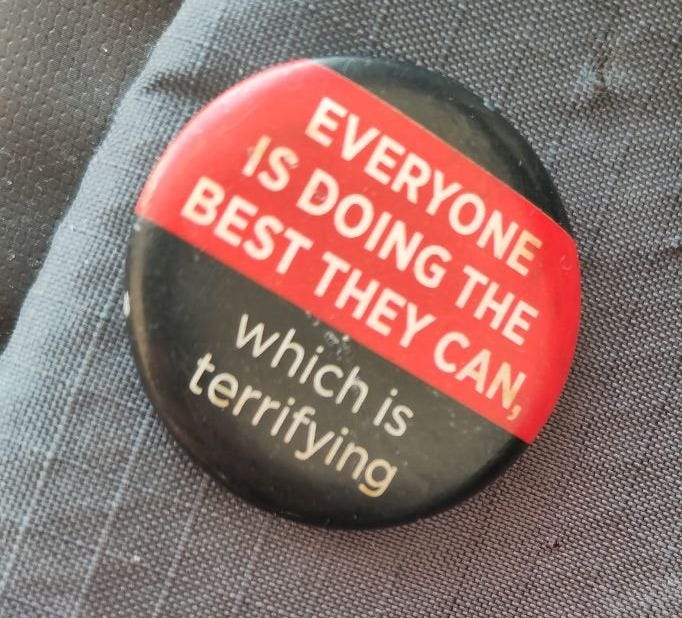
I wanna end with this photo of a pin that has accompanied me quite a while now, as it always reminds me of the same thought I gave room in this text: